

Vitamin D vs D3 often leaves Canadians standing in the pharmacy aisle wondering which supplement they actually need. They’re not alone. Health Canada estimates that about 1 in 5 people in Canada don’t get enough vitamin D, and the number of Canadians with very low levels more than doubles during winter. As the days grow shorter and sunlight fades, the vitamin D vs vitamin D3 debate becomes especially important. This is because many Canadians rely on supplements to maintain healthy vitamin D levels through the colder months.
In short, vitamin D3 is a sub-set of vitamin D. However, the full story involves chemistry, food sources, absorption, labels and cost. Therefore, this guide compares the two from every angle, so you can buy the best option for you.
Vitamin D vs D3: The Quick Answer
Simply put, “vitamin D” works as an umbrella term. Under that umbrella sit two main forms: D3, or cholecalciferol, and D2, or ergocalciferol. In other words, the vitamin D vs D3 debate really compares the whole family with one of its members.
So, when a label says “vitamin D,” check the ingredient list to see which form it contains. Most vitamin D supplements in Canadian pharmacies list D3, but some vegan and specialty products use D2.
What Is Vitamin D?
Vitamin D is a fat-soluble nutrient that helps your body absorb calcium and phosphorus. As a result, it keeps your bones and teeth strong. In addition, vitamin D supports muscle function and your immune system. Unlike most vitamins, your body can make vitamin D itself when sunlight hits your skin. However, at Canada’s northern latitude, once the long Canadian winter arrives, your body struggles to make enough vitamin D from sunlight alone.
What Is Vitamin D3?
Vitamin D3, or cholecalciferol, is the form your skin makes from sunlight. It also occurs naturally in animal foods such as fatty fish, egg yolks and cod liver oil. Most D3 supplements come from lanolin, a natural oil in sheep’s wool, while vegan versions come from lichen. Interestingly, Canadian dairies add vitamin D3 to milk after milking, during processing, and this is the same molecule your skin produces. For this reason, the vitamin D vs D3 question often has a simple answer at the grocery store: the D in your milk is D3.
What Is Vitamin D2?
Vitamin D2, or ergocalciferol, comes from plants and fungi. For example, mushrooms exposed to UV light make vitamin D2. Because no animals are involved, D2 has always suited vegans. Today, you’ll still find it in some supplements, prescription products in certain countries, and some fortified plant-based foods.
Vitamin D vs Vitamin D3: A Side-by-Side Comparison
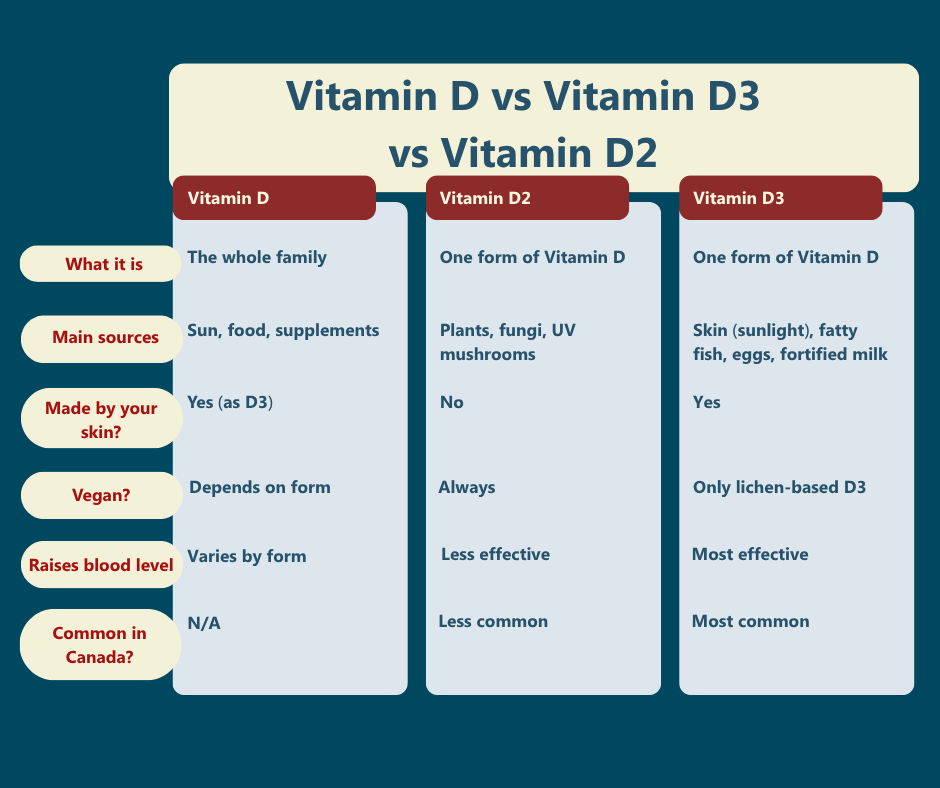
Clearly, this vitamin D vs vitamin D3 table shows that D3 checks more boxes for most people.
How Your Body Uses Both Forms for Vitamin D2 and D2 – A comparison
Although vitamin D2 and vitamin D3 come from different sources, your body processes them in a very similar way. First, your body absorbs both forms through the small intestine. Next, they travel to the liver, where your body converts them into a storage form called 25-hydroxyvitamin D. After that, the kidneys turn this stored vitamin D into its active form, which your body can use. Therefore, when your doctor orders a vitamin D blood test, the lab measures 25-hydroxyvitamin D.
The fact is, both vitamin D2 and D3 help your body absorb calcium and phosphorus. Consequently, they support strong bones, healthy teeth, proper muscle function, and a well-functioning immune system. In other words, both forms ultimately perform the same jobs once your body activates them.
However, the two forms differ in where they come from and how long they remain in your bloodstream. Vitamin D2 typically comes from plants and fungi, while vitamin D3 comes from animal sources and the vitamin D your skin produces after sun exposure. Furthermore, research suggests that vitamin D3 raises and maintains vitamin D levels more effectively than vitamin D2 in many people.
Nevertheless, both forms can help treat or prevent vitamin D deficiency when taken in appropriate amounts. Therefore, the best choice often depends on your dietary preferences, health needs, and your healthcare provider’s recommendations. Ultimately, whether you choose vitamin D2 or D3, the goal remains the same: maintaining healthy vitamin D levels to support your overall health.
Which Works Better? What the Research Shows on Vitamin D vs D3
Researchers have tested this question directly. Notably, a 2012 systematic review and meta-analysis led by Laura Tripkovic at the University of Surrey found that vitamin D3 raises the levels of vitamin D in the blood more effectively than D2. In fact, D3 produced a significantly greater increase in eight studies, no matter the dose, frequency or route, while two studies found the forms equally effective.
Later, a 2020 meta-analysis took a slightly softer view. It confirmed that both forms significantly raise blood levels, and it found a consistent trend favouring D3, although that difference did not reach statistical significance.
Overall, when it comes to vitamin D vs D3, D3 holds a modest but consistent edge.
Vitamin D vs Vitamin D3 in Canadian Food
Canada takes fortification seriously. Specifically, the law requires vitamin D in cow’s milk and margarine, and as of January 1, 2026, the level of vitamin D in both has doubled. Today, a cup of cow’s milk delivers about 200 IU, as does a cup of a plant-based beverage advertised as “fortified.”
However, fortification of goat’s milk and plant-based beverages stays voluntary, so not every carton contains vitamin D. In addition, the form of vitamin D in plant beverages may differ from the form in cow’s milk. Thus, people who drink plant-based beverages should pay close attention to the label to see whether the product contains vitamin D and which form (vitamin D2 that is ergocalciferol or vitamin D3 that is cholecalciferol).
Vitamin D vs D3 Supplements on Canadian Shelves
At the pharmacy, you’ll notice a few patterns:
- Dose limits: Health Canada allows non-prescription vitamin D products with up to 2,500 IU per dose. Higher strengths require a prescription.
- Forms: You’ll find tablets, softgels, chewables and drops. Drops suit kids and anyone who dislikes pills.
- Authorization: Look for an NPN or DIN, which shows Health Canada authorized the product.
- Vegan options: Lichen-based D3 now gives vegans the more effective form.
- Cost: Generally, both forms cost about the same, so price rarely decides the matter.
In practice, the vitamin D vs D3 choice at the pharmacy usually comes down to reading the ingredient list and picking D3.
How Much Do You Need?
Health Canada sets the same targets regardless of form. Specifically, adults aged 18 to 70 need 600 IU a day, and adults over 70 need 800 IU a day. Health Canada also recommends a daily 400 IU supplement for everyone over 50, and it sets the Tolerable Upper Intake Level at 4,000 IU per day.
Importantly, the vitamin D vs vitamin D3 dose guidelines don’t change: an IU of D2 and an IU of D3 count the same on a label. As a quick conversion, 40 IU equals 1 microgram.
Safety: Vitamin D vs D3 Side Effects
Fortunately, both forms prove very safe at recommended doses. However, because your body stores vitamin D in fat, too much of either form can build up over time. Exceeding upper limits may cause high blood calcium and kidney damage. Warning signs include nausea, vomiting, extreme thirst, frequent urination and confusion. Also, people with kidney stones, sarcoidosis, parathyroid disorders or kidney disease should talk to a doctor before they start any supplement.
Who Should Choose Which?
- Most adults: Choose D3 for the most reliable boost.
- Vegans: Pick lichen-based D3, or D2 if that’s all you can find.
- People with absorption problems (celiac disease, Crohn’s disease, bariatric surgery): Ask your doctor about the right form and dose.
- People with advanced kidney disease: Your doctor may prescribe calcitriol, the active form, because damaged kidneys can’t activate vitamin D well.
- Breastfed infants: Use infant drops, typically 400 IU a day, as your health-care provider advises.
For most Canadians, then, the vitamin D vs vitamin D3 decision has a clear winner.
Common Myths About Vitamin D vs Vitamin D3
Myth 1: D3 is a completely different vitamin. Actually, D3 is simply one form of vitamin D.
Myth 2: D2 doesn’t work. In reality, D2 is effective, but just a little less than D3.
Myth 3: More is always better. On the contrary, mega-doses can harm your kidneys, so stick to recommended amounts unless your doctor advises otherwise.
Myth 4: A sunny winter walk covers your needs in Canada. Unfortunately, the winter sun sits too low for your skin to make much vitamin D. In short, the vitamin D vs D3 question matters mostly because Canadian winters force us to rely on food and supplements.
Frequently Asked Questions
Are vitamin D and D3 the same thing?
Not exactly. Vitamin D names the whole family, while D3 names one form. Still, the vitamin D vs D3 confusion makes sense, since most supplements labelled “vitamin D” contain D3.
Can a blood test tell vitamin D vs vitamin D3 apart?
Usually, the standard test measures a total of 25-hydroxyvitamin D from both forms. Some labs can report D2 and D3 separately, but doctors rarely need that detail.
Which form works best for a Canadian winter?
Generally, D3, since it raises and maintains blood levels more effectively.
Can I switch from D2 to D3?
Yes. Most people can switch easily, but if your doctor prescribed a specific product, check with them first.
In Conclusion,
- Read the ingredient list. Look for cholecalciferol (D3) and an NPN or DIN.
- Choose D3 when you can. Research consistently shows a modest edge for D3 in raising blood levels.
- Don’t panic about D2. If you already take D2, it still works. You can simply switch to D3 when you finish the bottle.
- Mind the dose, not just the form. The vitamin D vs vitamin D3 debate matters far less than taking a sensible amount every day.
- Build a winter plan. Combine fortified milk or plant beverages, fatty fish and a daily supplement from fall through spring.
Ultimately, settling the vitamin D vs D3 question takes just a glance at the label. Once you choose a quality D3 at the right dose and take it consistently, you give your bones and muscles steady support through the long Canadian winter. And if you have a medical condition, the vitamin D vs vitamin D3 choice belongs in a quick conversation with your doctor or pharmacist.
Key Takeaways
- Vitamin D and D3 have different sources; D3 is more effective for raising blood levels.
- Vitamin D is essential for calcium absorption, bone health, and immune function; Canadians often need supplements, especially in winter.
- D3 is usually recommended for most adults, while vegans can consider lichen-based D3 or D2.
- Health Canada advises 600 IU daily for adults up to 70 and 800 IU for those over 70.
- Both forms are generally safe, but consulting with a healthcare provider is essential, especially for those with specific health conditions.
Estimated reading time: 9 minutes
