

The difference between ADD and ADHD confuses millions of people, and searches on the topic keep climbing on Google. According to the Government of Canada, 8.4% of Canadian children and youth aged 1 to 17 years were diagnosed with ADHD in 2023, an increase from 6.7% in 2019. ADHD is also common among adults, affecting an estimated 4% to 6% of the Canadian adult population. Similarly, the CDC reports that about 7.1 million U.S. children ages 3 to 17 have received an ADHD diagnosis, which equals roughly 11.4% of that age group. In reality, the ADD vs ADHD question has a simple answer, and this article walks you through it. Moreover, we compare symptoms, diagnosis, treatment, and daily life, so you can talk with your doctor with confidence.
What Is the Difference Between ADD and ADHD?
Here is the short answer. ADD stands for attention deficit disorder, and ADHD stands for attention deficit hyperactivity disorder. However, doctors no longer use ADD as a diagnosis. The American Psychiatric Association replaced the term in 1987, and its 1994 manual introduced the three presentations that clinicians use today. Therefore, the difference between ADD & ADHD comes down mostly to naming. ADD describes what doctors now call the inattentive presentation of ADHD. In other words, one is the full diagnosis, and the other is an outdated nickname for one part of it. Thus, a person who received an ADD label years ago would receive an ADHD diagnosis today, with the inattentive presentation noted.
ADD vs ADHD: How the Names Changed Over Time
History explains the confusion. In 1980, the third edition of the DSM (Diagnostic and Statistical Manual for Mental Disorders) listed “attention deficit disorder, with or without hyperactivity.” Seven years later, the revised edition merged both forms under the single name ADHD. Then, in 2013, the DSM-5 relabeled the old subtypes as “presentations” and kept ADHD as the one official diagnosis. Meanwhile, the public kept saying ADD. Parents, teachers, and even some clinicians never dropped the habit. Consequently, the ADD vs ADHD question still shows up in our daily conversation.
The Three Presentations of ADHD
Because ADD & ADHD belong to a single diagnosis, these three presentations clear up most of the confusion.
- Predominantly inattentive: trouble focusing, organizing, and finishing tasks (the group doctors once called ADD)
- Predominantly hyperactive-impulsive: constant movement, restlessness, and impulsive actions
- Combined: significant symptoms from both groups
Importantly, a person’s presentation can shift over a lifetime. For example, a hyperactive child may grow into an adult who feels restless inside but sits still outside.
Inattentive ADHD: The Condition People Call ADD
Inattentive ADHD produces quiet symptoms, so people often overlook them. Typical signs include:
- Missing details and making careless mistakes
- Struggling to stay focused during tasks, conversations, or reading
- Seeming not to listen when someone speaks directly
- Losing keys, phones, and paperwork
- Avoiding tasks that demand sustained mental effort
- Forgetting appointments and daily chores
However, these signs rarely disrupt a classroom. Therefore teachers and parents often miss them. This quiet profile explains why the difference between ADD and ADHD feels so large in daily life, even though both names point to one diagnosis.
Hyperactive-Impulsive and Combined ADHD
The hyperactive-impulsive presentation looks louder. People fidget, talk excessively, interrupt others, and struggle to wait their turn. Likewise, children may climb furniture or run when they should sit. Adults, on the other hand, often describe a constant sense of inner restlessness. The combined presentation includes both sets of symptoms. When people debate ADD vs ADHD, they often forget that all three presentations belong to the same condition.
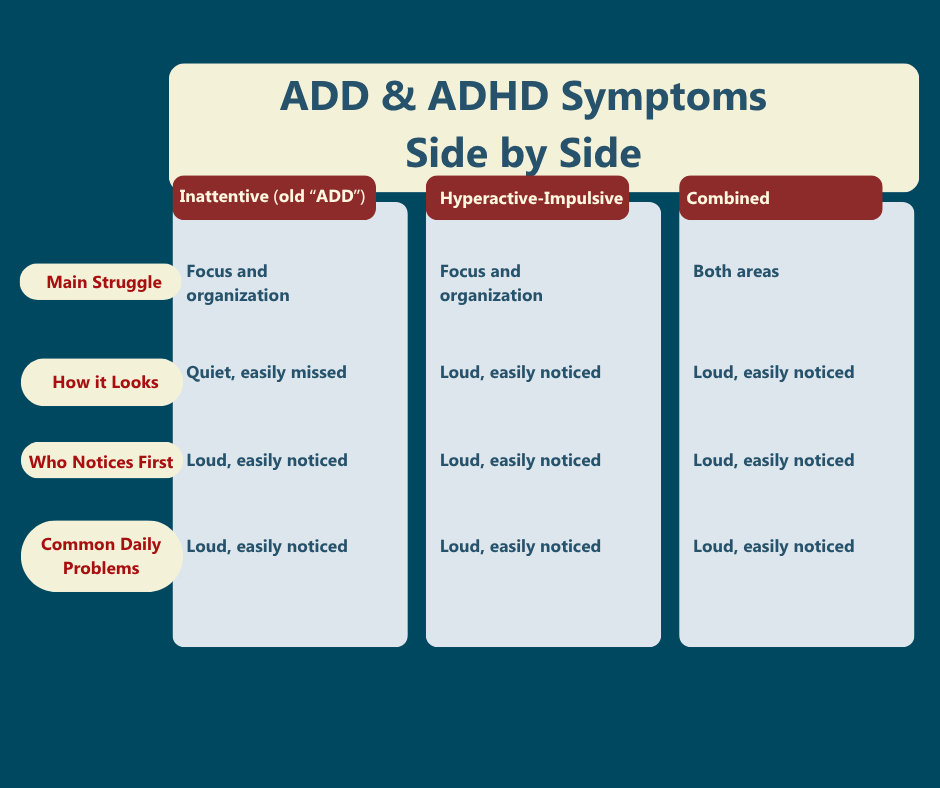
ADD & ADHD Symptoms Side by Side
The table below summarizes how the three presentations compare.
| Feature | Inattentive (old “ADD”) | Hyperactive-Impulsive | Combined |
| Main struggle | Focus and organization | Movement and impulse control | Both areas |
| How it looks | Quiet, easily missed | Loud, easily noticed | Varies by situation |
| Who notices first | Often no one for years | Teachers and parents | Teachers and parents |
| Common daily problem | Lost items, missed deadlines | Interrupting, restlessness | Both sets of problems |
The Difference Between ADD and ADHD in Children
Children with inattentive ADHD often daydream, lose homework, and finish tasks slowly. Because they rarely disrupt class, teachers may praise them for being quiet and miss the problem for years. Children with hyperactive symptoms, however, draw attention quickly, so they usually reach a doctor sooner. Additionally, boys receive diagnoses more often than girls, partly because boys show more visible hyperactivity. Therefore, parents who notice school struggles, lost belongings, or constant restlessness should ask the pediatrician for an evaluation.
The Difference Between ADD and ADHD in Adults
Adult ADHD rarely looks like the childhood version. Hyperactivity often fades into restlessness, but inattention and disorganization usually remain. For example, adults may miss deadlines, struggle with time management, and feel overwhelmed by paperwork. Similarly, many change jobs often or find relationships hard to maintain. In the ADD vs ADHD conversation, adults often say they have “ADD” because that was the name they heard growing up. Still, doctors diagnose them with ADHD today, and they can access the same treatments as everyone else.
Why Girls and Women Often Go Undiagnosed
Girls and women more often show the inattentive presentation, and many of them mask their symptoms. For instance, they may work extra hard to hide disorganization, or they may blame themselves instead of seeking help. As a result, many women receive an anxiety or depression diagnosis first and learn about ADHD in their thirties or forties. Furthermore, hormonal changes during the menstrual cycle, pregnancy, and menopause may intensify symptoms.
How Doctors Diagnose ADHD
No single blood test or brain scan diagnoses this condition. Instead, a clinician reviews your history, interviews you and often your family or teachers, and uses standardized rating scales. Doctors use the same evaluation for ADD & ADHD because both names describe one disorder. To qualify, a person generally needs six or more symptoms of inattention, hyperactivity-impulsivity, or both. People 17 and older need five. Furthermore, those symptoms must last at least six months, appear before age 12, and show up in two or more settings, such as home and work. Doctors also rule out conditions that mimic ADHD, including anxiety, depression, thyroid problems, sleep disorders, and learning disabilities. Notably, a clinician never diagnoses ADD vs ADHD as two separate conditions. Rather, the clinician identifies which presentation fits best.
Why the Difference Between Matters
Language shapes care. First, outdated terms can confuse insurance forms, school paperwork, and workplace requests, which all rely on the current diagnosis name. Second, calling inattentive ADHD “just ADD” can make the condition sound mild, so people may delay treatment. Third, accurate terms help you find reliable information, especially when you read about ADD vs ADHD online. Likewise, clear language about the condition helps schools and employers understand what you need.
ADD & ADHD Treatment Options
Treatment does not change with the name. In fact, the difference between ADD and ADHD has no effect on the core plan. Instead, the plan depends on the presentation, the severity, and the person’s goals. Most plans combine several approaches.
Medication. Stimulants such as methylphenidate and amphetamine remain the most widely used and best studied options. In contrast, non-stimulants such as Atomoxetine, Viloxazine, Guanfacine, and Clonidine help people who cannot tolerate stimulants. Meanwhile, doctors monitor blood pressure, heart rate, appetite, and sleep.
Behavioral therapy. Parent training helps families of young children, and cognitive behavioral therapy helps teens and adults build planning and time-management skills.
School and workplace support. Extra test time, written instructions, and quiet workspaces reduce daily friction.
Lifestyle habits. Regular exercise, steady sleep, and structured routines strengthen every other part of the plan.
Common Myths About Difference Between ADD and ADHD
Many people misunderstand the difference between ADD and ADHD, leading to common myths about symptoms, diagnosis, and treatment. Understanding the facts can help individuals recognize ADHD presentations and seek appropriate support when needed.
Myth 1: ADD & ADHD are two completely different conditions.
Fact: Healthcare professionals no longer use ADD as a separate diagnosis. They now use ADHD as the umbrella term, which includes inattentive, hyperactive-impulsive, and combined presentations.
Myth 2: People with ADD are not hyperactive, so they do not have ADHD.
Fact: People with predominantly inattentive ADHD may not show obvious hyperactivity, but they still have it.
Myth 3: Only children develop this condition.
Fact: ADHD often begins in childhood, but many people continue to experience symptoms throughout adolescence and adulthood.
Myth 4: ADHD only affects boys.
Fact: ADHD affects both males and females. Girls and women often show inattentive symptoms that can be harder to recognize.
Myth 5: If someone can focus on certain activities, they do not have ADHD.
Fact: Many people with this condition can focus intensely on activities they find engaging. ADHD affects the regulation of attention, not the ability to pay attention at all.
Myth 6: This condition results from poor parenting or lack of discipline.
Fact: ADHD is a neurodevelopmental condition. Parenting style does not cause ADHD.
Myth 7: People with inattentive ADHD are simply lazy or unmotivated.
Fact: ADHD can make it difficult to organize, prioritize, and complete tasks, even when someone is highly motivated.
Myth 8: Adults cannot have this condition.
Fact: ADHD frequently persists into adulthood and can affect work performance, relationships, and daily responsibilities.
Myth 9: Everyone with ADHD is overly energetic and disruptive.
Fact: Some people primarily experience difficulties with attention, organization, and forgetfulness rather than hyperactivity.
Myth 10: Understanding the difference between ADD and ADHD is complicated.
Fact: The key difference is simple. ADD is an older term that is no longer used clinically, while ADHD is the current medical diagnosis that includes inattentive symptoms as well as hyperactive and impulsive symptoms.
Living Well With This Condition
With the right plan, people with ADHD thrive. Regardless of the difference between ADD and ADHD, a few habits help everyone. To start, use calendars and phone reminders for appointments and deadlines. Next, break big tasks into small steps and reward yourself for finishing each one. ADDitionally, keep essentials like keys and wallets in one fixed spot. Exercise regularly and keep a steady sleep schedule, because both habits sharpen focus. Finally, tell trusted friends and coworkers what helps you. In short, ADD & ADHD respond to the same core strategies.
When to See a Doctor
See a doctor if symptoms last six months or longer and interfere with school, work, or relationships. Likewise, ask for help if anxiety, low mood, or substance use starts to build. Moreover, teachers, partners, and family members often notice patterns first, so listen when they raise concerns. Before your visit, write down specific examples from childhood and adulthood. Then, a single appointment can often clear up the difference between ADD and ADHD for you and your family.
In conclusion, the ADD vs ADHD debate matters less than the question underneath it: how do your symptoms affect your life? Therefore, focus on function. If attention, organization, or impulse control cause problems at home, school, or work, book an evaluation. A careful assessment separates ADHD from anxiety, depression, sleep problems, and thyroid disorders, and it opens the door to effective treatment. Understanding the difference between also gives you the language to advocate for yourself.
Finally, remember that both conditions describe one condition, and that condition responds well to the right plan. Please see a qualified clinician instead of relying on online quizzes or social media trends. An accurate diagnosis is the first step toward feeling more in control of your days.
Estimated reading time: 10 minutes
Key Takeaways
- The difference between ADD and ADHD confuses many; ADD is an outdated term for inattentive ADHD, while ADHD is the current diagnosis.
- This condition includes three presentations: predominantly inattentive, predominantly hyperactive-impulsive, and combined, with each showing different symptoms.
- Adults often refer to ADHD as ADD from childhood; however, the diagnosis remains ADHD regardless of the term used.
- Girls and women frequently go undiagnosed due to more subtle inattentive symptoms, leading to common misconceptions about ADHD’s prevalence.
- Understanding the difference between ADD and ADHD is crucial for accurate treatment and support, as both terms describe one condition.
