
High Cholesterol often develops silently, yet it can raise your risk of heart attack and stroke for years before symptoms appear. To Control LDL levels effectively, experts now look beyond diet and genetics alone. New research suggests that high LDL cholesterol may also rise because a hidden biological pathway reduces the liver’s ability to remove LDL from the bloodstream. Recent findings could change how doctors understand and manage lipid in the future.
Heart disease remains one of the leading causes of illness and death worldwide. Therefore, researchers continue to search for new ways to improve treatment. While statins and other medicines help many people, some individuals still struggle to reach healthy targets.
What Is High Cholesterol?
High Cholesterol occurs when its levels in the blood rise above healthy ranges. It is a waxy, fat-like substance (lipid) that your body needs to build cells, hormones, and vitamin D. However, too much cholesterol can become harmful.
Your blood contains several types of cholesterol:
- The bad LDL (low-density lipoprotein)
- The good HDL (high-density lipoprotein)
- Triglycerides, a type of fat that stores energy
Among these markers, doctors pay special attention to high LDL cholesterol because excess LDL can build up inside artery walls. Over time, these deposits form plaque. Consequently, blood flow becomes restricted, which increases the risk of cardiovascular disease.
Health Canada and the Canadian Cardiovascular Society emphasize the importance of managing LDL because lowering LDL reduces cardiovascular risk. Therefore, people with elevated LDL often benefit from lifestyle changes and, when necessary, medication.
Why Controlling High LDL Cholesterol Matters
Many people feel perfectly healthy despite having high LDL cholesterol. Unfortunately, this condition often develops without warning signs.
When LDL particles circulate in the bloodstream for long periods, they can:
- Enter artery walls
- Trigger inflammation
- Contribute to plaque formation
- Narrow blood vessels
- Increase the risk of heart attack
- Raise the risk of stroke
As plaque grows, arteries lose flexibility. Furthermore, blood flow becomes less efficient. If a plaque ruptures, a blood clot can form suddenly. Consequently, a person may experience a serious cardiovascular event.
Because of these risks, healthcare providers encourage patients to Control LDL before complications develop.
How the Liver Helps Control LDL
The Liver’s LDL Receptors Controls High LDL Cholesterol
Your liver is your body’s cholesterol management center. It continuously removes LDL from the bloodstream.
To perform this task, liver cells use specialized structures called LDL receptors. These receptors function like docking stations. They capture LDL particles and pull them into liver cells for processing and removal.
When the liver has more LDL receptors:
- It removes more LDL from circulation.
- Blood LDL levels decrease.
- Cardiovascular risk falls.
When receptor numbers decline:
- LDL remains in the bloodstream longer.
- Blood cholesterol rises.
- The risk associated with high LDL cholesterol increases.
This process explains why many medications focus on preserving or increasing LDL receptors.
High Cholesterol and the New Hidden Driver
For many years, researchers knew that diets high in cholesterol reduce the liver’s ability to clear LDL. However, they did not fully understand why.
A 2026 study from researchers at the University of California San Diego identified a previously unknown mechanism that may help explain persistent High Cholesterol. According to the study, excess dietary cholesterol activates proteins called Ral GTPases. These proteins trigger a chain of events that causes LDL receptors to disappear from liver cells. As a result, the liver removes less LDL from the bloodstream. In simple terms:
- High cholesterol intake activates a signaling pathway.
- The pathway destroys LDL receptors.
- The liver loses part of its cholesterol-clearing capacity.
- LDL levels rise.
- High Cholesterol becomes harder to manage.
Researchers also identified an enzyme called CTSA (cathepsin A) as an important player in this process.
Why This Discovery Matters for High LDL Cholesterol
This discovery adds another piece to the puzzle.
Most current medications target cholesterol production or well-known LDL receptor pathways. However, this newly identified pathway appears different. Therefore, it may offer another treatment option for people who do not achieve desired results with existing therapies.
Researchers used a CTSA inhibitor in animal studies. The treatment stabilized LDL receptors and significantly lowered circulating LDL in mice. In addition, the drug had already completed an early human safety trial for another condition. This research could help accelerate future cholesterol research. However, researchers have not yet demonstrated its benefits in humans.
Although more research remains necessary, these findings highlight a new strategy to Control LDL levels. For example this research may eventually lead to new treatment options for patients who struggle to Control LDL with current therapies. Most importantly, the findings explain another reason why high LDL cholesterol can persist even when existing treatments target other pathways.
How to Control LDL Effectively
Start Controlling High Cholesterol with Heart-Healthy Eating
Diet remains one of the most effective tools to Control LDL.
Many Canadians lower LDL levels by making consistent dietary changes. While no single food solves the problem, healthier eating patterns can make a significant difference.
Focus on:
- Vegetables
- Fruits
- Whole grains
- Beans and lentils
- Nuts and seeds
- Fish rich in omega-3 fats
At the same time, limit:
- Processed foods
- Fried foods
- Excess saturated fat
- Excess trans fat
Furthermore, increasing soluble fiber can help remove cholesterol from the body. Oats, barley, beans, and psyllium are excellent choices.
Maintain a Healthy Weight to Balance High Cholesterol
Excess body weight often contributes to high LDL cholesterol.
Even modest weight loss can improve cholesterol levels. Therefore, healthcare providers often recommend gradual and sustainable weight management.
Helpful strategies include:
- Eating regular balanced meals
- Monitoring portion sizes
- Increasing physical activity
- Reducing sugary beverages
Exercise Regularly to Control LDL
Physical activity supports cardiovascular health in many ways.
Regular exercise can:
- Improve cholesterol balance
- Raise HDL cholesterol
- Support weight management
- Improve blood pressure
- Enhance insulin sensitivity
For most adults, experts recommend at least 150 minutes of moderate-intensity activity each week.
Walking, cycling, swimming, and dancing all provide benefits. Moreover, consistency matters more than intensity.
If you want to Control LDL, regular movement should form part of your long-term strategy.
Avoid Smoking
Smoking damages blood vessels and accelerates plaque formation.
Even when high LDL cholesterol appears only moderately elevated, smoking can significantly increase cardiovascular risk.
After quitting, the body begins repairing itself almost immediately. Furthermore, cardiovascular risk decreases over time.
For many people, smoking cessation becomes one of the most powerful steps they can take to improve heart health.
Limit Alcohol Consumption
Excess alcohol can raise triglycerides and contribute to weight gain.
Although moderation varies from person to person, reducing alcohol intake often supports healthier cholesterol management.
If you already have High Cholesterol, discuss alcohol use with your healthcare provider.
Medical Treatment Options for High Cholesterol
Statins
Statins remain the first-line treatment for many patients with High Cholesterol.
These medications work by reducing cholesterol production in the liver. Consequently, the liver increases LDL receptor activity and removes more cholesterol from circulation.
Extensive research shows that statins lower cardiovascular risk.
Ezetimibe
Ezetimibe reduces cholesterol absorption in the intestine. Therefore, ezetimibe serves as a useful add-on therapy for people trying to Control LDL more effectively.
Doctors often prescribe it when:
- Statins alone do not achieve LDL targets
- Patients require additional LDL reduction
- Higher statin doses are not suitable
PCSK9 Inhibitors
PCSK9 inhibitors help preserve LDL receptors.
As a result, the liver clears more LDL cholesterol from the bloodstream.
These medications may benefit people with:
- Familial hypercholesterolemia
- Very high cardiovascular risk
- Persistent high LDL cholesterol despite treatment
Future Therapies and New Research to Control LDL
The recent UC San Diego findings may eventually expand treatment options.
Researchers discovered that blocking CTSA prevented LDL receptor loss in animal studies. Consequently, the liver maintained a greater ability to remove LDL cholesterol.
Importantly, the researchers noted that this pathway differs from mechanisms targeted by statins and PCSK9 inhibitors. Therefore, future therapies may work alongside existing treatments rather than replace them.
While human studies remain necessary, this research offers hope for people who continue to struggle with High Cholesterol despite lifestyle changes and current medications.

When Should You Check Your Cholesterol?
Many adults do not know their cholesterol numbers.
However, lipid testing helps identify risk before symptoms develop.
You may benefit from testing if you:
- Are over age 40
- Have diabetes
- Have high blood pressure
- Smoke
- Have a family history of heart disease
- Have a family history of high LDL cholesterol
Healthcare providers may recommend more frequent testing based on individual risk factors.
How to Read Cholesterol Test Results
When reviewing results, many people focus only on total cholesterol. However, LDL often provides a more meaningful picture of cardiovascular risk.
Your report may include:
LDL Cholesterol
This value reflects the amount of low-density lipoprotein cholesterol in your blood.
Generally, lower LDL levels indicate lower cardiovascular risk.
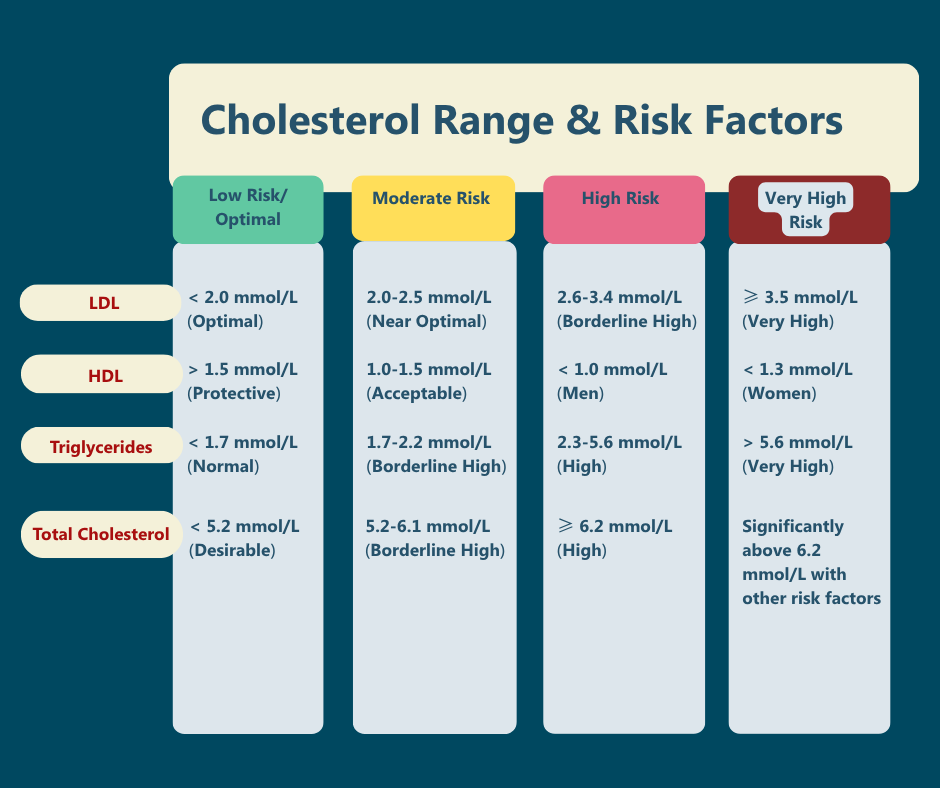
General LDL Cholesterol Ranges (mmol/L):
- Optimal: Less than 2.0 mmol/L (for many high-risk patients)
- Near optimal: 2.0-2.5 mmol/L
- Borderline high: 2.6-3.4 mmol/L
- High: 3.5-4.9 mmol/L
- Very high: 5.0 mmol/L or higher
HDL Cholesterol
Higher HDL levels often support better heart health.
General HDL Cholesterol Ranges (mmol/L):
- Less than 1.0 (men)- Increased cardiovascular risk
- Less than 1.3 (women)-Increased cardiovascular risk
- 1.0-1.5- Acceptable
- Above 1.5- Protective for heart health
Triglycerides
Elevated triglycerides may increase cardiovascular risk.
General Triglyceride Ranges (mmol/L):
- Normal: Less than 1.7 mmol/L
- Borderline high: 1.7-2.2 mmol/L
- High: 2.3-5.6 mmol/L
- Very high: Greater than 5.6 mmol/L
High triglycerides often improve with regular exercise, weight management, and reduced intake of sugary and highly processed foods.
Total Cholesterol
This measurement combines several lipid components.
Because risk varies from person to person, your healthcare provider will interpret these values within the context of your age, medical history, medications, and overall cardiovascular risk.
General Total Cholesterol Ranges (mmol/L):
- Desirable: Below 5.2 mmol/L
- Borderline high: 5.2-6.1 mmol/L
- High: Above 6.2 mmol/L
However, healthcare providers rarely make decisions based on total cholesterol alone. Instead, they place greater emphasis on LDL and overall cardiovascular risk.
Non-HDL Cholesterol
Many clinicians now pay close attention to non-HDL cholesterol because it captures all potentially harmful particles.
General Non-HDL Cholesterol Ranges (mmol/L):
Non-HDL cholesterol can provide a clearer assessment of cardiovascular risk.
- Optimal: Less than 2.6 mmol/L
- Borderline high: 3.4-4.0 mmol/L
- High: Above 4.1 mmol/L
What Numbers Should You Aim For?
For many healthy adults:
- LDL: Below 2.0-2.5 mmol/L
- HDL: Above 1.0 mmol/L for men and 1.3 mmol/L for women
- Triglycerides: Below 1.7 mmol/L
- Total: Below 5.2 mmol/L
However, patients with diabetes, previous heart attack, stroke, peripheral artery disease, or other cardiovascular risk factors often require much lower LDL targets. A healthcare provider can help determine the safest goal for your situation.
In conclusion, when you receive a cholesterol test result, do not focus on total cholesterol alone. Instead, review your LDL, HDL, triglycerides, and overall cardiovascular risk with a healthcare professional. By understanding your numbers early, you can make informed decisions about diet, exercise, medication, and other strategies to Control LDL and protect your long-term heart health. Health Canada and Canadian cardiovascular guidelines continue to support routine risk assessment and evidence-based lipid management as key measures for preventing heart disease.
Estimated reading time: 10 minutes
Key Takeaways
- High Cholesterol can develop silently, raising heart attack and stroke risks; it often requires new strategies for effective management.
- Recent research highlights a hidden biological pathway affecting how the liver clears LDL cholesterol, complicating treatment efforts.
- The liver’s LDL receptors play a crucial role in managing LDL levels; preserving these receptors can decrease cardiovascular risks.
- Diet, weight management, exercise, and avoiding smoking and excessive alcohol are key lifestyle changes to control High Cholesterol effectively.
- New treatment options may emerge from research targeting the mechanisms behind LDL receptor loss, offering hope for those struggling with High Cholesterol.
