

Red light therapy for arthritis and stem cell therapy for arthritis are two distinct non-traditional approaches used to manage arthritis symptoms. Both have attracted considerable attention among people looking for alternatives to conventional arthritis treatment. However, these two approaches work very differently, and neither should automatically replace established treatments. While red light therapy for arthritis uses specific wavelengths of light to influence pain and tissue responses, stem cell therapy for arthritis uses cell-based injections that modify inflammation, tissue repair, or joint function. Therefore, a thorough understanding of each treatment matters before deciding which option may provide the best arthritis pain relief.
The quest for a cure for arthritis has also encouraged interest in newer treatments. However, arthritis includes many different diseases, so one treatment cannot work equally well for every patient. Consequently, the best treatment depends on the type of arthritis, the affected joint, disease severity, age, overall health, and previous treatment response.

What Is Red Light Therapy for Arthritis?
Red light therapy for arthritis, (also known as photobiomodulation or low-level laser therapy), uses red or near-infrared light at specific wavelengths. Healthcare professionals can deliver the light through devices that place the light over or near the affected area.
Unlike an injection, red light therapy for arthritis does not require a needle or the introduction of cells into the joint. Instead, photobiomodulation attempts to produce biological effects within exposed tissues through light energy.
Researchers have studied red light therapy for arthritis particularly in knee osteoarthritis. A 2024 systematic review and meta-analysis included 10 randomized placebo-controlled studies involving 542 participants. The researchers found that photobiomodulation reduced pain at rest compared with placebo, although the certainty of evidence remained very low. The researchers therefore concluded that photobiomodulation may complement other treatments rather than serve as an isolated treatment.
| Biological Phase | Physiological Action | Clinical Benefit |
| Stage 1: Penetration | Red and near-infrared light wavelengths pass directly through skin and soft tissue. | Reaches damaged joint structures non-invasively. |
| Stage 2: Cellular Absorption | Mitochondria inside targeted cells absorb light photons. | Boosts cellular ATP energy production and metabolism. |
| Stage 3: Anti-Inflammatory Response | Cellular signals decrease inflammatory cytokines and elevate micro-circulation. | Decreases localized joint swelling, heat, and fluid buildup. |
| Stage 4: Functional Relief | Damaged tissues receive enhanced oxygenation and nutrients. | Delivers significant red light therapy for arthritis pain relief and restores range of motion. |
How Does Red Light Therapy for Arthritis Work?
The exact biological mechanisms of red light therapy for arthritis remain an active area of research. Scientists propose that specific wavelengths can influence cellular activity and inflammatory processes.
Importantly, red light therapy for arthritis does not simply “replace damaged cartilage.” Marketing claims sometimes make photobiomodulation sound like a regenerative treatment that rebuilds an arthritic joint. However, current evidence does not justify such a broad claim.
Instead, the strongest clinical interest involves symptom management. Therefore, red light therapy for arthritis may have a role in reducing pain or improving function for some people, particularly when clinicians use it alongside exercise and other evidence-based therapies.
A 2025 umbrella review found evidence of benefit for osteoarthritis-related disability, although the researchers also emphasized limitations in the evidence base, the need for standardized protocols and better-quality trials.
Key features of red light therapy for arthritis include:
- Non-Invasive Nature: Applies light pads or lasers directly to the skin without needles or surgical incisions.
- Rapid Cellular Activation: Increases local blood circulation and decreases pain-causing inflammatory markers.
- Convenient Home Use: Provides daily management through handheld panels or wearable targeted wraps.

What Is Stem Cell Therapy for Arthritis?
Stem cell therapy for arthritis refers to several different cell-based approaches rather than one standardized treatment.
Clinics and researchers may use mesenchymal stromal cells obtained from sources such as bone marrow or adipose tissue. Some approaches use cells that doctors process during the treatment, while others use expanded or otherwise prepared cell products.
Therefore, stem cell therapy for arthritis does not describe one uniform procedure. The source of the cells, processing method, cell concentration, preparation, injection technique, and treatment protocol can vary considerably.
This variation creates an important problem when comparing studies. Two treatments may both carry the label stem cell therapy for arthritis, yet they may use completely different biological products.
How Does Stem Cell Therapy for Arthritis Work?
Researchers hope that stem cell therapy for arthritis can influence the joint environment through anti-inflammatory, immunomodulatory, and tissue-related mechanisms.
However, patients should understand an important distinction. Stem cell therapy for arthritis does not necessarily mean that injected cells will become new cartilage and permanently rebuild the joint.
Researchers continue to investigate how these cells behave after injection. Some proposed effects involve signaling molecules and interactions with existing cells rather than direct replacement of damaged cartilage.
Recent research has produced encouraging findings. A 2024 systematic review and meta-analysis of 25 randomized controlled trials involving 1,048 participants found that advanced mesenchymal stromal cell therapy produced better pain outcomes than viscosupplementation at 12 months in patients with knee osteoarthritis. Nevertheless, the researchers noted that robust evidence regarding clinical applicability remains limited.
A more recent meta-analysis of 28 randomized trials also reported improvements in some pain and functional outcomes with mesenchymal stromal cell therapy. However, the analysis found no consistent MRI evidence of structural improvement and reported higher rates of injection-site pain and joint swelling in treated patients.
Therefore, stem cell therapy for arthritis remains promising, but researchers still need stronger evidence regarding long-term effectiveness, standardization, safety, and structural joint preservation.
Key features of stem cell therapy for arthritis include:
- Biologic Regeneration: Encourages biological healing by releasing growth factors that signal damaged tissues to repair.
- Invasive Injections: Requires precise, image-guided intra-articular needle injections administered by specialist physicians.
- Clinical Setting: Demands outpatient medical clinic procedures rather than home-based application.
Red Light Therapy for Arthritis vs Stem Cell Therapy for Arthritis
When patients compare red light therapy for arthritis with stem cell therapy for arthritis, they should first recognize that these treatments occupy very different positions.
Red light therapy for arthritis is noninvasive. It does not require an injection, harvesting of cells, or laboratory expansion of cells. Consequently, patients generally avoid the procedural risks associated with injections.
On the other hand, stem cell therapy for arthritis requires an injection or another method of delivering cells to the treatment area. Therefore, the procedure carries risks related to the injection itself and to the biological product.
Secondly, red light therapy for arthritis currently has relatively modest evidence for symptom improvement, particularly in knee osteoarthritis. The 2024 meta-analysis found potential pain benefits but rated the certainty of evidence very low.
Meanwhile, stem cell therapy for arthritis has generated more extensive clinical research, particularly for knee osteoarthritis. Several randomized trials and meta-analyses report improvements in pain and function. However, researchers have not established one standardized stem cell product or demonstrated consistent long-term cartilage regeneration.
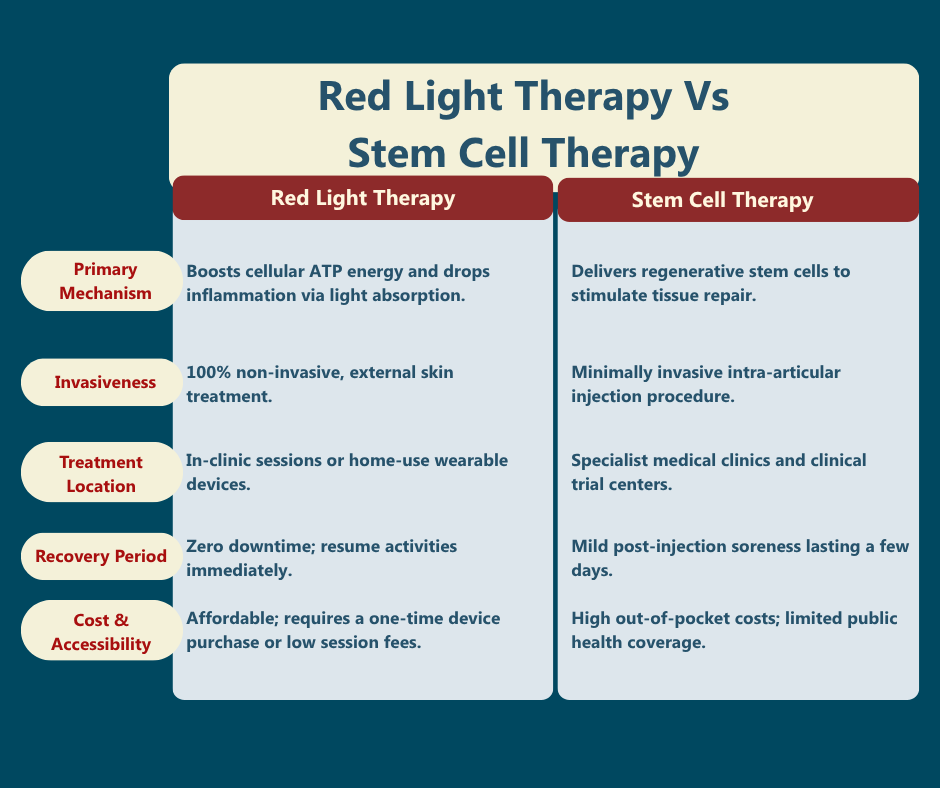
Comparing Red Light Therapy for Arthritis vs. Stem Cell Therapy for Arthritis
| Comparison Attribute | Red Light Therapy for Arthritis | Stem Cell Therapy for Arthritis |
| Primary Mechanism | Boosts cellular ATP energy and drops inflammation via light absorption. | Delivers regenerative stem cells to stimulate tissue repair. |
| Invasiveness | 100% non-invasive, external skin treatment. | Minimally invasive intra-articular injection procedure. |
| Treatment Location | In-clinic sessions or home-use wearable devices. | Specialist medical clinics and clinical trial centers. |
| Recovery Period | Zero downtime; resume activities immediately. | Mild post-injection soreness lasting a few days. |
| Cost & Accessibility | Affordable; requires a one-time device purchase or low session fees. | High out-of-pocket costs; limited public health coverage. |
Which Is Better: Red Light Therapy for Arthritis or Stem Cell Therapy for Arthritis?
For many patients, red light therapy for arthritis may make more sense as a low-risk complementary treatment rather than a replacement for standard care.
Because red light therapy for arthritis avoids injections, it may appeal to patients who want a noninvasive option. However, patients should maintain realistic expectations because current evidence does not establish it as a cure.
Meanwhile, stem cell therapy for arthritis may appear more attractive because it involves a biological product and because some clinical studies report meaningful improvements. Nevertheless, the higher cost, procedural nature, variability among products, and unresolved long-term questions require careful consideration.
Is There a Cure for Arthritis?
Patients often search for a cure for arthritis, particularly when pain interferes with walking, sleeping, working, or exercising.
Unfortunately, red light therapy has not established a permanent cure for arthritis. Likewise, stem cell therapy has not established a universal cure for arthritis.
This distinction matters because some clinics market regenerative treatments as if they can permanently restore damaged joints. Current evidence does not support such a broad claim.
For osteoarthritis, treatment generally focuses on reducing pain, improving function, maintaining mobility, and addressing modifiable risk factors. Likewise, for autoimmune arthritis, doctors use medications that control abnormal immune activity. Similarly, for gout, treatment can lower urate levels and prevent recurrent attacks.
Consequently, the search for a cure for arthritis should not lead patients to abandon treatments with established benefits.
What About Arthritis Pain Relief?
Both red light therapy for arthritis and stem cell therapy for arthritis primarily attract attention because patients want better arthritis pain relief.
However, arthritis pain relief should start with an accurate diagnosis.
For osteoarthritis, exercise and physical therapy remain important components of treatment. Strengthening muscles around an affected joint can improve function and reduce pain. Weight management can also help appropriate patients, particularly when excess body weight increases mechanical stress on weight-bearing joints.
Medications can provide additional arthritis pain relief when appropriate. Depending on the patient and the joint involved, clinicians may consider topical or oral medications and selected injections.
Therefore, red light therapy for arthritis can potentially complement these measures rather than replace them.
Similarly, stem cell therapy for arthritis should not automatically replace exercise, rehabilitation, medication, or other established treatments.
What About Pool Therapy for Arthritis?
Aquatic or pool therapy provides another useful option for arthritis pain relief.
Water reduces the effective load on joints while still allowing patients to move against resistance. As a result, people who struggle with land-based exercise may find aquatic exercise more comfortable.
Pool therapy can include walking in water, range-of-motion exercises, strengthening exercises, and supervised therapeutic programs.
Unlike red light therapy for arthritis, aquatic therapy actively involves movement. Furthermore, unlike stem cell therapy for arthritis, pool therapy does not involve injections or biological products.
Other Established Treatments for Arthritis
Patients should not overlook conventional treatments while exploring red light therapy for arthritis or stem cell therapy for arthritis.
Physical therapy can improve strength and joint mechanics. Occupational therapy can help patients modify activities and protect joints. Assistive devices can also improve mobility when appropriate.
For inflammatory arthritis, disease-modifying medications can reduce inflammation and prevent joint damage. Likewise, for gout, urate-lowering treatment can prevent recurrent attacks. Similarly, for severe osteoarthritis, joint replacement surgery can provide substantial improvement when conservative treatment no longer provides adequate function or arthritis pain relief.
Consequently, the most effective arthritis treatment often combines several strategies rather than relying on one therapy.
What New Arthritis Treatments Are Researchers Studying?
Researchers continue to investigate new approaches that could eventually improve arthritis treatment.
Scientists are studying improved cell-based therapies, tissue engineering, injectable biomaterials, gene-based approaches, and drugs designed to influence disease mechanisms.
Some researchers also investigate treatments designed to modify osteoarthritis itself rather than simply reduce symptoms. This concept could eventually change how doctors approach a disease that currently has limited disease-modifying options.
However, patients should distinguish emerging research from established treatment. A therapy can show encouraging results in laboratory studies or early clinical trials without becoming an approved or routinely recommended treatment.
Therefore, an upcoming therapy should not automatically receive the same level of confidence as a treatment supported by multiple high-quality clinical trials.
What About the Safety of Stem Cell Therapy for Arthritis?
Safety deserves particular attention with stem cell therapy for arthritis.
A systematic review of stem cell-based injections for knee osteoarthritis found that temporary adverse events occurred in some patients, with swelling and injection-site pain among the most common problems. The researchers also emphasized substantial variation among treatment protocols and the need for longer-term safety data.
In addition, patients should verify exactly what a clinic means by stem cell therapy for arthritis. The term can cover very different products and procedures.
In the United States, the FDA states that regenerative medicine therapies have not been approved for treating orthopedic conditions such as osteoarthritis. The agency has also warned about risks associated with illegally marketed regenerative medicine products.
Even Canada has strict, federally regulated rules around stem cell therapies, including those marketed for arthritis. Most “stem cell treatments” offered by private clinics are legally considered drugs/biologics and cannot be sold or administered without Health Canada authorization.
What counts as “stem cell therapy” under Canadian law?
The term covers very different things — and the rules depend on how the cells are processed.
- Minimally manipulated cells (e.g., simple washing or separation)
- More-than-minimally manipulated cells (expanded, cultured, enzymatically processed, etc.)
- Autologous (your own cells) vs allogeneic (donor cells)
Health Canada states that autologous stem cell products (including fat‑derived, bone‑marrow‑derived, or point‑of‑care processed cells) — even when prepared at point‑of‑care — meet the definition of a drug under the Food and Drugs Act. This means they require evidence of safety and efficacy, manufacturing controls, quality testing, regulatory authorization before use before being offered to patients.
That means they cannot be sold, advertised, or administered unless one of the following is true:
- The product has a Health Canada market authorization
- The clinic is running an approved clinical trial
- The patient is receiving it through the Special Access Program (SAP)
Canada currently has no authorized stem cell product for osteoarthritis.
So if a clinic is offering “stem cell therapy for arthritis” outside those pathways, they are not operating within federal law.
Regulatory status varies by country, so patients should also check the rules and approvals that apply where they live.
The Bottom Line: Which Therapy Should You Choose?
Neither red light therapy nor stem cell therapy currently represents a universal cure for arthritis.
For most patients, the better strategy involves identifying the specific arthritis diagnosis first and then building a treatment plan around proven approaches. Exercise, physical therapy, aquatic therapy, weight management when appropriate, medications, injections, and surgery can all have roles depending on the condition.
From a clinical perspective, patients should approach both red light therapy for arthritis and stem cell therapy for arthritis with informed optimism rather than unrealistic expectations.
Red light therapy for arthritis has a reasonable rationale and some encouraging evidence for symptom improvement, but current research does not establish it as a standalone cure. Stem cell therapy for arthritis has generated stronger interest in regenerative medicine, but researchers still have important questions about long-term effectiveness, treatment standardization, structural regeneration, and safety.
Frequently Asked Questions About Red Light Therapy & Stem Cell Therapy
No. Manitoba Health Card does not cover stem cell therapy for arthritis. Patients must pay out-of-pocket for these non-covered biological injection procedures.
Yes, clinical studies indicate that stem cell therapy can effectively reduce pain scores, decrease local inflammation, and improve physical functioning in patients suffering from ankle arthritis.
Yes, research demonstrates that stem cell therapy reduces hip pain scores and improves overall joint function for many osteoarthritic patients.
Red light therapy stimulates cellular mitochondria, boosting ATP production, enhancing micro-circulation, and reducing inflammatory markers surrounding swollen joints.
Yes, photobiomodulation research shows that red light therapy effectively reduces chronic knee pain, decreases morning joint stiffness, and restores functional mobility.
The best red light therapy devices for arthritis include FDA-cleared targeted joint wraps, clinical-grade LED panels, and specialized low-level laser pads that feature medical-grade 660nm red and 850nm near-infrared light wavelengths.
Direct stem cell therapy injections for arthritis are generally not available locally in Winnipeg or public healthcare facilities in Manitoba, as direct stem-cell joint injections remain experimental or restricted outside of specialized clinical trials.
You can get red light therapy (often referred to as low-level laser therapy or cold laser therapy) for arthritis at several specialized physiotherapy, chiropractic, and wellness clinics across Winnipeg.
Ask the clinic to provide their Health Canada authorization number or clinical trial ID, confirm the details in Health Canada’s drug/biologic database and public clinical‑trial registries. You can also check with your provincial medical college for guidance on whether the procedure is compliant.
Key Takeaways
- Red light therapy for arthritis uses specific wavelengths of light to manage symptoms, while stem cell therapy involves cell-based injections.
- Both treatments are non-traditional approaches for arthritis and have different mechanisms of action.
- Red light therapy reduces inflammation and improves function, but it isn’t a cure; it has modest evidence for symptom management.
- In contrast, stem cell therapy shows promise in pain relief but lacks standardized protocols and long-term effectiveness.
- Patients should consider established treatments like physical therapy alongside these therapies for optimal results.
